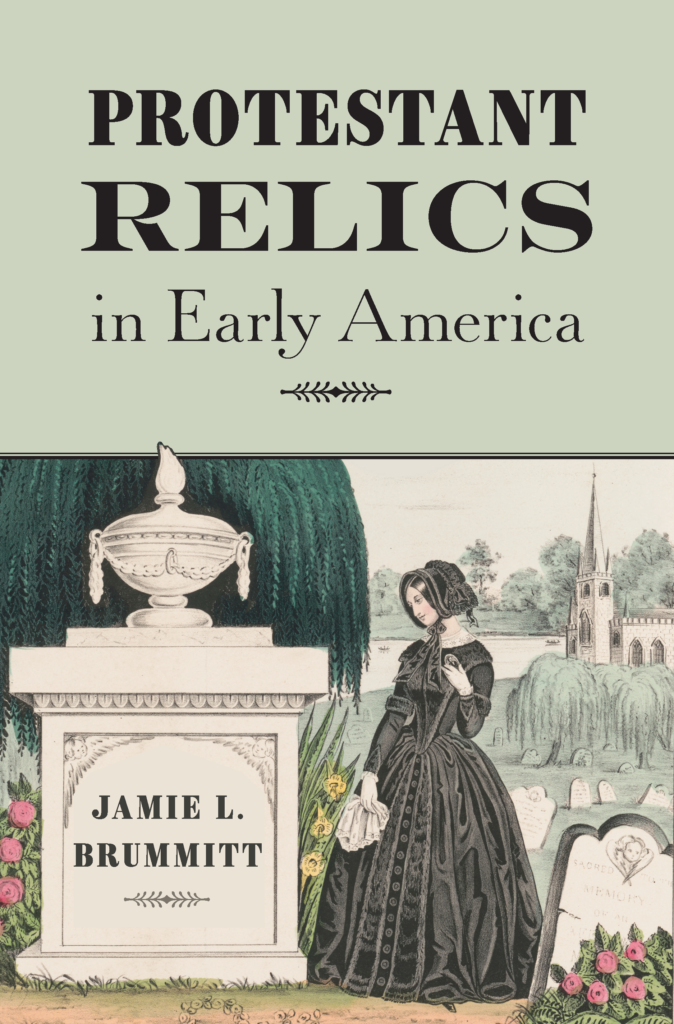
New York: Oxford University Press, 2025.
In Protestant Relics in Early America, Jamie L. Brummitt upends long-held assumptions about religion and material culture in the early United States. Brummitt chronicles how American Protestants cultivated a lively relic culture centered around collecting supernatural memory objects associated with dead Christian leaders, family members, and friends. These objects materialized the real physical presences of God, Jesus, the Holy Spirit, and souls of the dead on earth.
As Brummitt demonstrates, people of nearly all Protestant denominations and walks of life–including members of Congress, college presidents, ministers, mothers, free Black activists, schoolchildren, and enslaved people–sought embodied and supernatural sense experiences with relics. They collected relics from deathbeds, stole relics from tombs, made relics in schools, visited relics at pilgrimage sites like George Washington’s Mount Vernon, purchased relics in the marketplace, and carried relics into the American Revolution and the Civil War. Locks of hair, blood, bones, portraits, daguerreotypes, post-mortem photographs, memoirs, deathbed letters, Bibles, clothes, embroidered and painted mourning pieces, and a plethora of other objects that had been touched, used, or owned by the dead became Protestant relics. These relic practices were so pervasive that they shaped systems of earthly and heavenly power, from young women’s education to national elections to Protestant-Catholic relations to the structure of freedom and families in the afterlife.
In recovering the forgotten history and presence of Protestant relics in early America, Brummitt demonstrates how material practices of religion defined early American politics and how the Enlightenment enhanced rather diminished embodied presence. Moreover, Brummitt reveals how the modern historical method has obscured the supernatural significance of relics for the Protestants who made, collected, exchanged, treasured, and passed them down. This book will be an essential resource for scholars and students of early American history, religion, politics, art, and popular culture.
Featured in

“Visually Sacred” Podcast
Listen to an interview with Jamie L. Brummitt about Protestant Relics in Early America on “Visually Sacred: Conversations on the Power of Images,” a podcast that explores how images influence experiences of the sacred.

The Living Church
Brummitt’s Protestant Relics in Early America highlighted for its attention to relic collecting in Anglican and Episcopalian history in The Living Church, a magazine serving the Episcopal Church and Anglican Communion since 1878.

John Fea’s Blog
Read an interview with Jamie L. Brummitt about her new book Protestant Relics in Early America on John Fea’s “The Way of Improvement Leads Home,” a blog featuring top scholarly work in the field of American history

ARC: Religion, Politics, Etc.
Read an excerpt of Jamie L. Brummitt’s Protestant Relics in Early America in ARC: Religion, Politics, Et Cetera, a project of the John C. Danforth Center on Religion and Politics at Washington University in St. Louis.
Praise for Protestant Relics in Early America
“Jamie Brummitt’s provocative volume skillfully refutes longstanding assumptions about Protestant devotional cultures to offer a richly researched, thoughtfully articulated, incisive account of the socialities, polities, and politics of Protestant relics and reliquaries. The author grounds her arguments in nuanced readings of Reformation and Enlightenment epistemologies and in the everyday material features of Protestant relics practices, issuing a compelling invitation to (re)consider Protestant matter, its energies and animating capacities. A must-read for scholars of material and sensory history as of religion, Brummitt’s study illuminates an avid Protestant devotional culture firmly dedicated to retaining ‘the real presences of the ordinary dead’ and deeply implicated in American constructions of race, gender, religion, and nation.”
— Sally Promey, Professor of American Studies and Religious Studies, Yale University
“In this extravagantly illustrated and richly detailed work, Jamie Brummitt explores how ‘enlightened supernatural memory objects’—relics—shaped Protestant, and thus American, culture. What is more, they emerged within a Protestant milieu supposedly resistant to relics, and within the context of an Enlightenment epistemology. This work should shake up, and reshape, the history of the material culture of American Protestantism.”
— Paul Harvey, Distinguished Professor of History, University of Colorado Colorado Springs
“Brummitt turns commonplace conceptions of what constitutes a relic on their head, making a convincing case for how a wide range of early American Protestants endowed objects with supernatural power, a view too often only associated with Catholic practice. Brummitt offers here a book full of startling insights and carefully crafted arguments. It is a truly amazing achievement.”
— Paul C. Gutjahr, Ruth N. Halls Professor of English, Indiana University
“Jamie Brummitt’s Protestant Relics in Early America is an exceptional contribution to the discipline of religious studies, as well as a fascinating slice of American history. Once opened, this book is impossible to put down. It is not only an indispensable resource for both seasoned scholars and students but is refreshingly engaging. Protestant Relics in Early America will undoubtedly shape the discourse of the material culture of religion and anthropology for years to come.”